To buy crypto on Binance, complete identity verification, choose a route that accepts the funds you already have, review the final amount received, and confirm both order completion and your asset balance. Card purchases and P2P can turn outside money into crypto; Convert and Spot are alternatives when you already hold a supported balance.
Availability depends on your account, region, currency and asset. Cryptocurrency can lose value; a convenient purchase method does not make an asset suitable for your finances.
Documentation checked: October 23, 2026. This guide uses official public Binance documentation and public-page checks. All numerical examples below are explicitly hypothetical, not live quotes or executed trades.
Choose a route from your starting balance
Start with two questions: what do you currently hold, and what do you want to receive? Then compare routes that are actually available in your account.
| Starting point | Route to consider | Main decision |
|---|---|---|
| Money on a supported bank card | Direct card purchase | Is the final crypto amount worth the total charge? |
| Money with a supported local payment provider | P2P | Do the advertisement, payment rules and counterparty fit? |
| A supported Binance balance | Convert | Is the previewed exchange amount acceptable? |
| A funded Spot wallet and suitable trading pair | Spot | Do you need immediate execution or a price limit? |
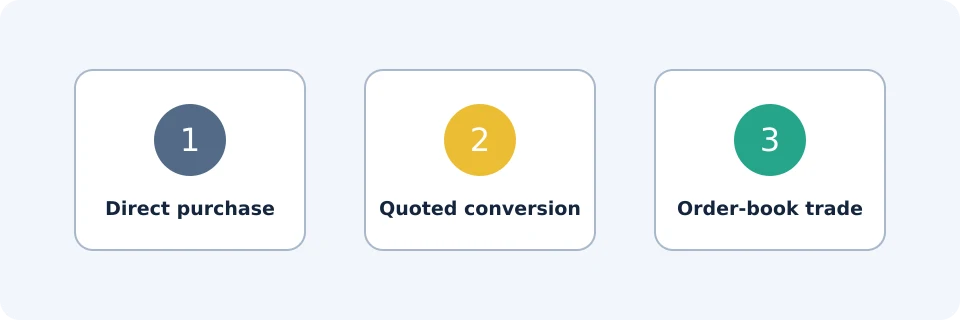
A bank deposit followed by a trade may also be available. Compare the whole journey, including funding costs and any intermediate exchange, rather than only the last step. Binance’s beginner guide documents card, bank-transfer, P2P, Convert and Spot routes; it does not establish universal availability.
Before funding, finish the verification requested by your account and enable strong authentication. See the FinanceVelix guides to registration and verification and account security.
Compare the final quote, not just the advertised fee
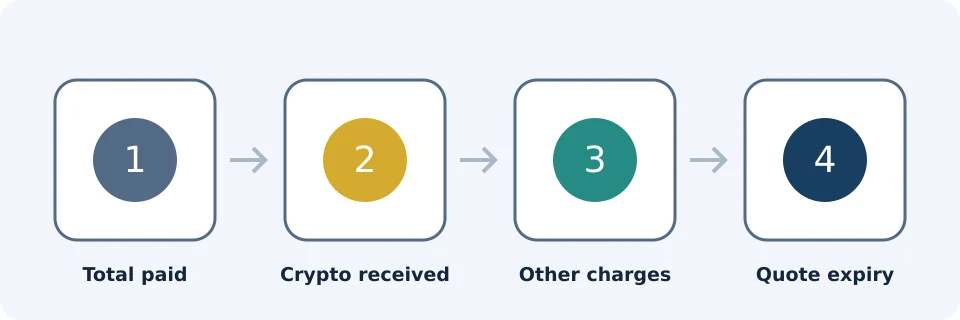
Record four things before confirming: total payment, net crypto received, separate charges and quote expiry. The exchange rate can matter as much as an explicit fee. A route advertising zero trading fees is not necessarily the route delivering the most crypto.
Worked example: the same 100-unit spend
Assume two executable quotes each cost exactly 100 units of the same payment currency, with no additional charges. Both deliver BTC to an equally usable balance.
| Measure | Quote A | Quote B |
|---|---|---|
| Total paid | 100 | 100 |
| Net BTC received | 0.00150 BTC | 0.00147 BTC |
| Effective cost per BTC | 66,666.67 | 68,027.21 |
Effective unit cost = total payment ÷ net crypto received. Quote B delivers 0.00003 BTC less: 0.00003 ÷ 0.00150 × 100 = 2% less BTC than A. Its unit cost is approximately 2.04% higher. The percentages differ because their denominators differ.
Now suppose A triggers a separate 2-unit issuer charge. Its total cost becomes 102, giving 102 ÷ 0.00150 = 68,000 per BTC. That nearly eliminates its advantage over B. This extra charge is an invented assumption, not a Binance fee schedule.
Use quotes taken close together. If your second route requires another conversion, include that conversion’s costs before comparing. Keep withdrawal costs separate unless both alternatives include delivery to the same external destination.
Buying directly with a card
- Open the official Binance site or app and find the purchase function.
- Select your payment currency, desired asset and spending amount.
- Choose an available card payment option. Use a card registered in your own name.
- Review the payment total, conversion rate, transaction fee and expected crypto amount.
- Complete any bank authentication, then check the resulting order status.
The official card-purchase instructions, checked October 23, 2026, say prices and corresponding crypto amounts can recalculate before confirmation. They also warn that some banks classify crypto purchases as quasi-cash and impose additional charges. Ask your issuer about those charges rather than assuming the Binance quote includes them.
If a quote expires, review a fresh one. Do not treat the earlier amount as a price guarantee. Interface labels can vary, so follow the current account flow rather than expecting identical screens.
Buying through P2P
P2P means buying from another user through an in-platform order, with an external payment method. Select your currency and payment method, then examine the advertisement’s price, minimum and maximum amounts, counterparty details and payment conditions.
Binance documents an escrow mechanism that holds the crypto during the transaction in its P2P introduction. Escrow does not remove payment or counterparty risk.
- Use the in-platform order process and agreed payment method; do not move the deal to private messaging.
- Follow identity and payment-name requirements shown for the order.
- Only mark payment completed after actually sending it.
- If you have paid but the crypto is not released, retain payment evidence and use the order’s appeal process rather than paying again.
Do not assume every P2P market has zero fees. Applicable platform fees can depend on the market, and payment-provider charges are separate. The FinanceVelix P2P guide covers transaction safeguards in more detail.
Using an existing balance: Convert or Spot
Convert: judge the previewed result
Select the source asset, destination asset and amount, then preview the conversion. Confirm only after checking the amount you will receive. You need sufficient supported balance, and an expired quote needs another review.
The official Convert guide describes Instant, Recurring and Limit options. For a one-off purchase, distinguish immediate conversion from a future instruction. A limit conversion is not guaranteed to execute merely because a displayed market price crosses your chosen level.
Spot: choose execution behavior
Select the correct pair and check which asset you are spending. For example, buying BTC in BTC/USDT spends USDT to acquire BTC; it does not charge a bank card.
A market order takes available liquidity, so its final average price can differ from the last displayed trade. A limit order sets your price boundary but may remain open or fill only partially. The official Spot guide explains these order types.
Review executed quantities and fees, not only the submitted order amount. If part remains unfilled, decide whether to keep or cancel the remainder before placing another order. See Spot order examples for further explanation.
Verify receipt and troubleshoot problems
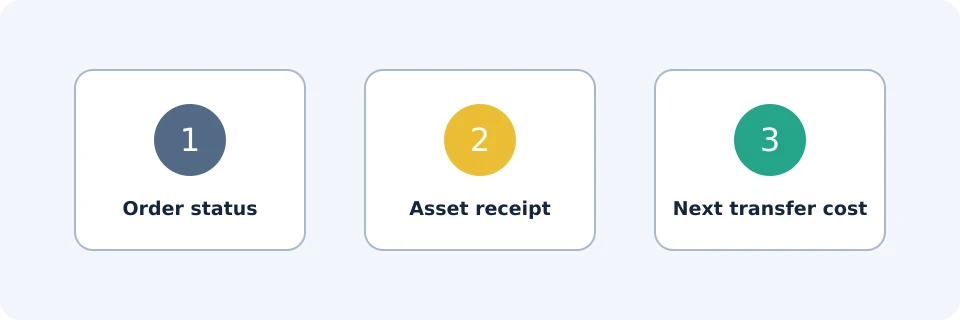
A bank authorization, submitted trade or payment confirmation is not by itself proof that the crypto arrived. Match the order record to the actual asset balance. Save the final payment, received quantity, fees and order reference.
| Problem | Useful next action |
|---|---|
| Card declined | Read the failure reason, check card validity and ask the issuer about crypto restrictions before retrying. |
| Quote expired or changed | Request a new quote and compare its final amount again. |
| Payment deducted but order failed | Check the order record and issuer statement. Binance says failed card payments deducted are refunded, but appearance on the statement may take a few days. |
| Order pending or partly filled | Identify whether payment is processing or a trading instruction remains open. Avoid a duplicate purchase while uncertain. |
| Less crypto than expected | Compare the confirmed rate, fees and actual fills with the earlier estimate. |
The card FAQ documents failed-order details and support inquiry options. If unresolved, contact support through the official account with the order reference; never share authentication codes.
Frequently asked questions
Which purchase route is cheapest?
Compare the same total spend and final asset received at roughly the same time. Include issuer charges, intermediate exchanges and applicable trading fees. No route wins universally.
Can I use a credit card?
Only if your account and issuer support it. Binance documentation covers credit and debit cards, but the issuer may restrict crypto purchases or charge extra.
Do referral benefits apply to every purchase?
No universal application or stacking should be assumed. A 20% referral rebate, where offered to an eligible account, is distinct from BNB fee deduction and task-based welcome rewards. Check each product’s terms; none automatically discounts every card or P2P purchase.
Must I withdraw immediately after buying?
Buying and withdrawing are separate decisions. Before an external transfer, check the destination address, supported network, any required memo, fee and net amount. See the withdrawal guide.
Why has my limit order not bought anything?
Your price condition and available liquidity may not permit execution. Check whether it is open, partially filled, canceled or completed before changing your plan.
Affiliate disclosure
FinanceVelix may earn a commission from registrations through its Binance referral link. Eligibility and benefits depend on region, account and applicable terms. This guide is not a recommendation to buy cryptocurrency.
Official educational references
- How to Buy Crypto with Credit/Debit Card on Binance Website? | How to buy crypto,Binance buy crypto,How to use Binance ↗Source accessed: 2026-10-23
- Binance beginner guide ↗Source accessed: 2026-10-23
- How to use Binance Convert ↗Source accessed: 2026-10-23
- Guide to Binance Spot trading ↗Source accessed: 2026-10-23
- Binance VELIX registration offer ↗Source accessed: 2026-10-23