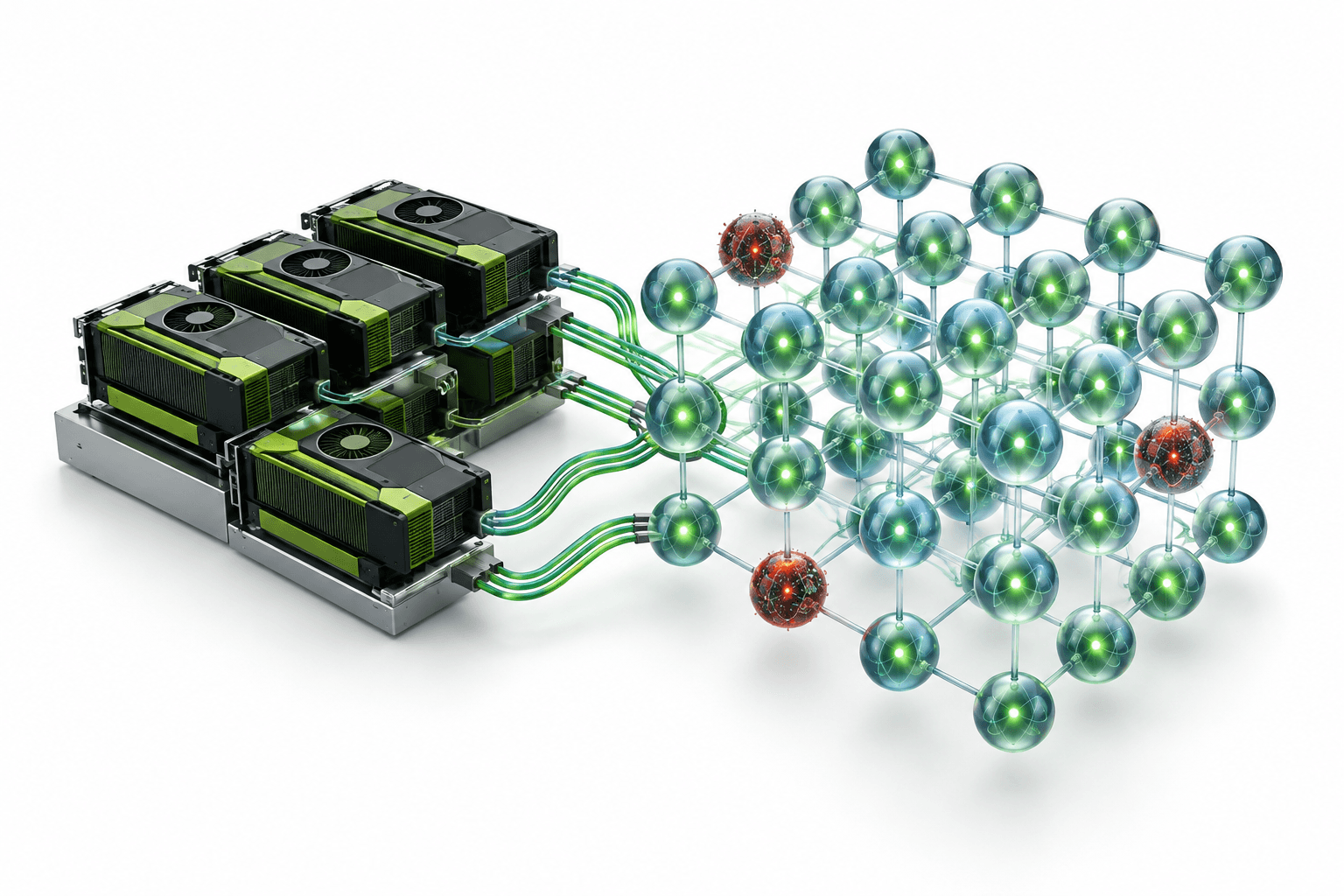
Nvidia quantum simulation research reached a 104-qubit protocol on Europe’s JUPITER supercomputer, the company announced on October 19, 2026. Working with Jülich Supercomputing Centre researchers, the team used 8,192 Nvidia GH200 GPUs to model the preparation of special quantum states needed for fault-tolerant computing. The work was a simulation on conventional computing hardware, not the operation of a completed fault-tolerant quantum computer.
Key Takeaways
- The simulation modeled a protocol spanning 104 physical qubits, including data and auxiliary qubits.
- Researchers tested hardware imperfections that simpler quantum models can miss.
- The project supports quantum processor design rather than demonstrating a commercial quantum application.
Table of Contents
- Nvidia quantum simulation targets a resource-intensive task
- Detailed error modeling raises the computing burden
- A research benchmark, not a commercial deployment
- Conclusion
Nvidia quantum simulation targets a resource-intensive task
Nvidia’s technical account of the JUPITER simulation describes work on magic-state preparation. These specially prepared quantum states enable operations needed for universal quantum computation, but producing them reliably can consume a substantial share of a quantum computer’s resources.
The team studied part of a process called magic-state cultivation: preparing a state in a small error-correcting code, checking it for faults and expanding it into a larger code. Understanding how errors affect that sequence can help researchers assess the resources and error-control methods a future processor would require.
| Item | Details |
|---|---|
| Simulation software | Nvidia CUDA-Q and cuQuantum. |
| Encoded register | 45 binary storage bits in the 8,192-GPU configuration. |
| Represented state | Approximately 35.2 trillion complex amplitudes. |
| State memory | 512 TiB in double precision, equivalent to 64 GiB per GPU. |
Detailed error modeling raises the computing burden
The model included coherent phase errors, which can accumulate and interfere, and leakage, where a superconducting qubit leaves its usual two computational levels. Selected sites were therefore modeled with a third energy level, increasing the simulation’s complexity.
To make the calculation manageable, the software reorganized operations while preserving their dependencies and measurement statistics. It also reused storage as qubits were measured and released, allowing the full protocol to be followed with a smaller evolving quantum state.
Development and validation took place at the Nvidia Accelerated Quantum Research Center alongside large-scale runs on JUPITER. That parallel workflow allowed software testing to continue without waiting for the largest supercomputer allocations.
A research benchmark, not a commercial deployment
The practical value is a more detailed reference for examining how hardware imperfections propagate through quantum circuits. Researchers can use that reference to test more compact simulation methods and investigate which errors deserve closer attention when designing processors.
The announcement does not establish a commercial quantum-computing deployment or quantify a financial contribution to Nvidia. Its stated longer-term objective is to connect the behavior of noisy magic-state preparation with the quality and cost of operations consumed by quantum applications.
Conclusion
The result gives researchers a detailed benchmark for studying a demanding component of fault-tolerant quantum computing. The next research step outlined is to apply the workflow to different leakage models, circuit schedules and error-correction protocols; no timetable was specified.
Read More News
Disclaimer
This FinanceVelix article provides general information, not personalized financial, investment, legal, or tax advice. Market prices, interest rates and economic conditions can change; investments carry a risk of loss. Facts reflect the material available when published and may change. Check important information independently and consult a qualified professional when needed. Mentioning an asset, company, or service is not an endorsement.