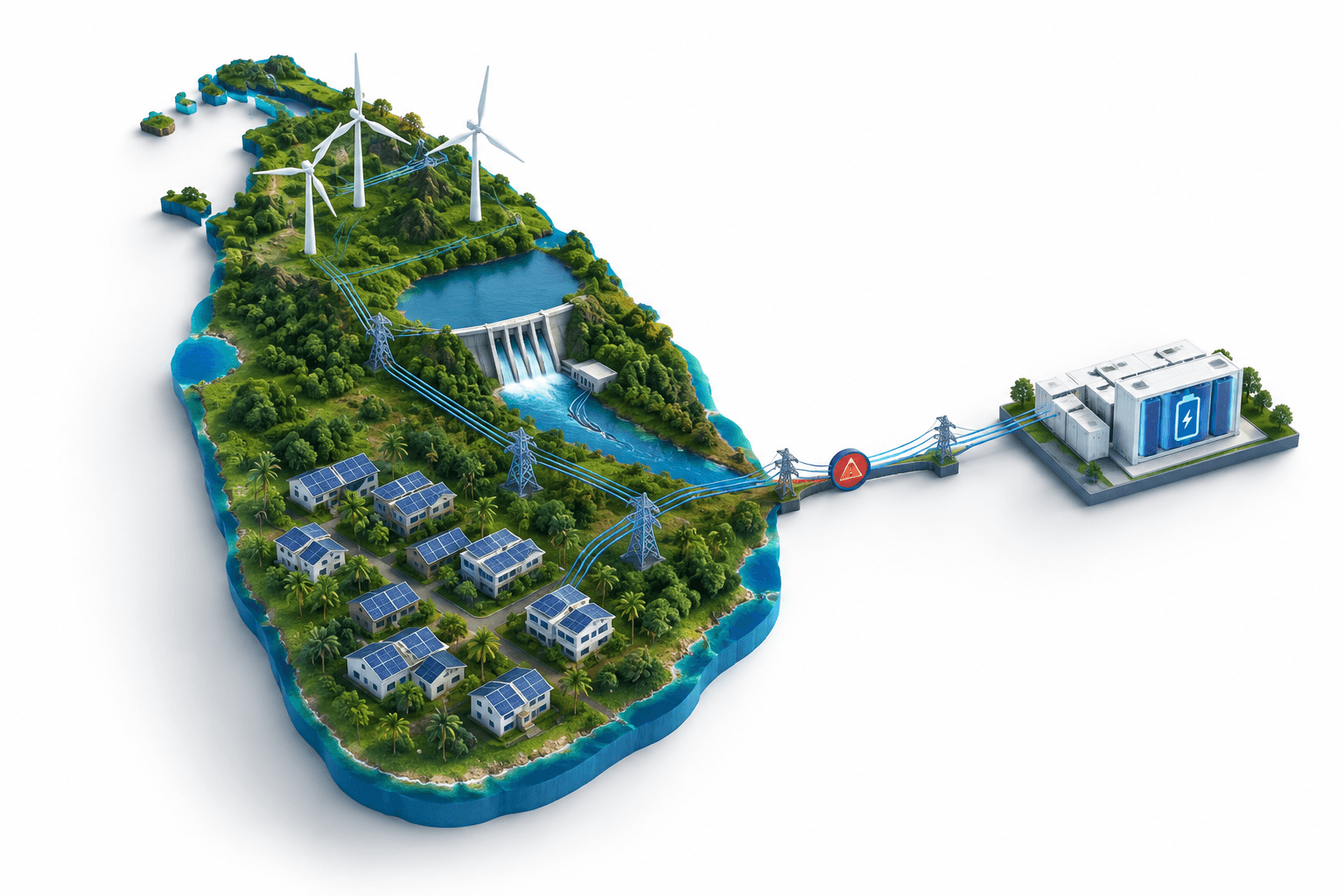
Renewable energy expansion has become more urgent for Sri Lanka after soaring oil costs, but transmission bottlenecks, solar pricing and opposition to wind farms are complicating the transition. In October 2026, Energy Minister Anura Karunathilaka said the government wanted to accelerate the shift while warning that infrastructure was not ready to replace fossil-fuel generation completely.
Key Takeaways
- Sri Lanka may seek to exceed its existing 70% renewable electricity target for 2030.
- Grid constraints and surplus daytime solar generation are limiting how much renewable power the system can absorb.
- The government plans transmission upgrades, battery storage and a proposed overhaul of solar electricity pricing.
Table of Contents
- Renewable energy ambitions rise after oil shocks
- Grid capacity is the immediate bottleneck
- Solar pricing reform would change who bears the cost
- Wind projects face local resistance
- Conclusion
Renewable energy ambitions rise after oil shocks
Sri Lanka imports all its oil and gas needs, leaving the economy exposed to higher international fuel costs. Increases in fuel, gas and electricity prices, alongside rationing, have added pressure to a country still recovering from its 2022 economic crisis.
Karunathilaka said Sri Lanka would probably need to go beyond its existing goal of generating 70% of electricity from renewable sources by 2030. Renewables currently account for around 60%, including about 40% from hydropower.
The target predates the latest oil shock. The Cabinet's Renewable Energy Resources Development Plan 2025–2030, approved on February 2, 2026, sets out the 70% objective and covers suitable land, resource mapping and renewable energy park development, including floating solar projects.
| Item | Details |
|---|---|
| Estimated wind potential | 30 gigawatts |
| Solar capacity ambition | Nearly 4,400 megawatts by 2029, the minister said |
| Solar expansion comparison | The 2029 ambition represents a 388% increase from 2024 |
| Longer-term renewable ambition | 90–95% within 10–15 years, alongside reduced coal and naphtha use |
Grid capacity is the immediate bottleneck
The minister identified transmission capacity, grid control and fluctuations in supply and demand as major constraints. Five major transmission network lines are planned from 2027, although he said those additions alone would not be enough.
Rapid installation of solar panels on homes and businesses has created periods when daytime electricity generation exceeds demand. Operators sometimes curtail solar plants to maintain system stability, Karunathilaka said.
A six-hour island-wide blackout occurred in October 2026 after the national grid tripped. Excess solar generation was cited as a possible cause, not an established finding. The government also plans to expand battery storage to help manage the imbalance between generation and consumption.
Solar pricing reform would change who bears the cost
Karunathilaka said the government would propose a new financial model for solar electricity. Under the arrangement he described, private producers can export power during the day and draw back an equivalent amount without charge at night, when electricity is more expensive.
The minister called that arrangement financially unsustainable, saying the state bears the additional cost. His proposed reform is intended to balance the interests of solar producers and consumers; he did not provide a replacement tariff or implementation date.
The distinction matters for the expansion plan: installing more panels increases potential output, but pricing, storage and grid capacity determine how effectively that electricity can be used.
Wind projects face local resistance
On the northwestern Mannar peninsula, residents blame turbines operating since 2020 for flooding, declining fish activity and threats to migratory birds. Those are community concerns, rather than established findings presented by the minister.
Karunathilaka said only projects already approved or under construction would proceed in Mannar, with future wind farms located elsewhere. He also cautioned that investment and infrastructure were not yet sufficient to replace coal and naphtha completely.
Conclusion
The next planned infrastructure step is the transmission expansion beginning in 2027. Sri Lanka's renewable energy ambitions will also depend on battery investment and the details of the proposed solar pricing model, for which no implementation date was provided.
Read More News
Disclaimer
This FinanceVelix article provides general information, not personalized financial, investment, legal, or tax advice. Market prices, interest rates and economic conditions can change; investments carry a risk of loss. Facts reflect the material available when published and may change. Check important information independently and consult a qualified professional when needed. Mentioning an asset, company, or service is not an endorsement.