Binance Futures fees start with the commission on each executed fill. The applicable rate depends on the contract, fee tier, maker or taker execution and any eligible discount or promotion. Opening and closing a position can both incur commission. Funding payments and liquidation-related charges are separate items.
This guide shows how to calculate those costs and reconcile them with a trade record. Public rates were checked on October 23, 2026. Examples below are invented calculations, not trades we placed, and do not include every possible charge. Futures availability depends on your jurisdiction and account; leverage can cause rapid losses.
What are the current Binance Futures trading fees?
The official Futures fee table showed the following Regular User USDT-margined rates when checked. This is a dated reference for that row, not a universal rate for every Binance Futures contract or account.
| USDT-margined execution | Standard rate | Displayed BNB discount rate |
|---|---|---|
| Maker | 0.0200% | 0.0180% |
| Taker | 0.0500% | 0.0450% |
The same page displayed separate USDC/USD1 promotional columns and a U-margined promotion. Those are different products and conditions. Before calculating a real trade, select the contract and relevant tier, then read the applicable row and campaign terms again. Do not substitute a search snippet's older rate for the current schedule.
A useful rate record contains the checking date, contract symbol, account tier, maker/taker rate and discount setting. Keep the record with your calculation. If a later fee differs, this identifies which assumption to investigate rather than leaving a single unexplained percentage.
Maker and taker describe execution, not just order names
The official fee-calculation guide distinguishes adding liquidity from taking existing liquidity. A limit order can execute immediately against resting orders. Calling an order “limit” does not prove that all of its fills receive a maker rate.
The Futures order-type guide explains Post Only: it is intended to add liquidity and is canceled if it would immediately match. It does not guarantee that an order will fill later. A lower potential commission should not be confused with a guaranteed execution price or an assured exit.
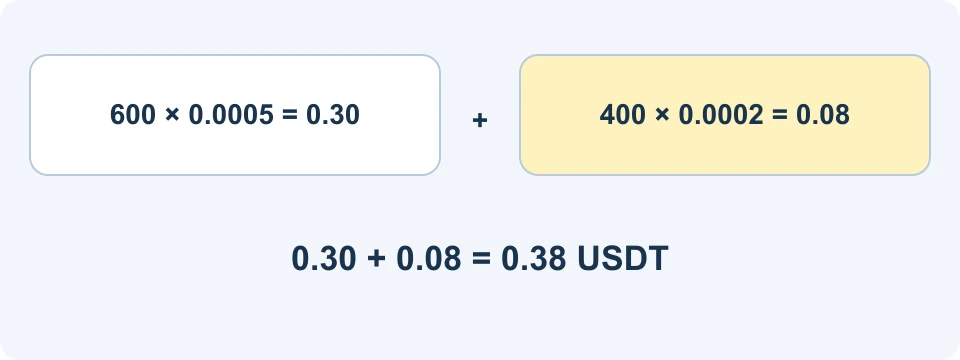
In that hypothetical split, applying the taker rate to the entire 1000 USDT would produce 0.50 USDT. Applying the maker rate to everything would produce 0.20 USDT. Neither reproduces the actual assumed mix. Calculate each fill first, then add the results.
How to calculate commission on a filled trade
For the standard USD-margined example, the calculation is quantity multiplied by execution price multiplied by the applicable fee rate. Convert a percentage to its decimal form: 0.05% is 0.0005. A price shown before submission is not necessarily the final execution price.
Binance's calculation guide gives a different contract-value calculation for COIN-margined contracts: contract count multiplied by the contract multiplier, divided by execution price, then multiplied by the fee rate. Use the actual multiplier and settlement units for that contract. Do not transplant a USDT result into a BTC fee column.
For a personal worksheet, label the units beside every input. “Quantity” might mean base-asset units in one product and contract count in another. Write the formula only after resolving that distinction. A numerically neat result with the wrong unit is still an incorrect fee estimate.
A round trip uses both entry and exit values
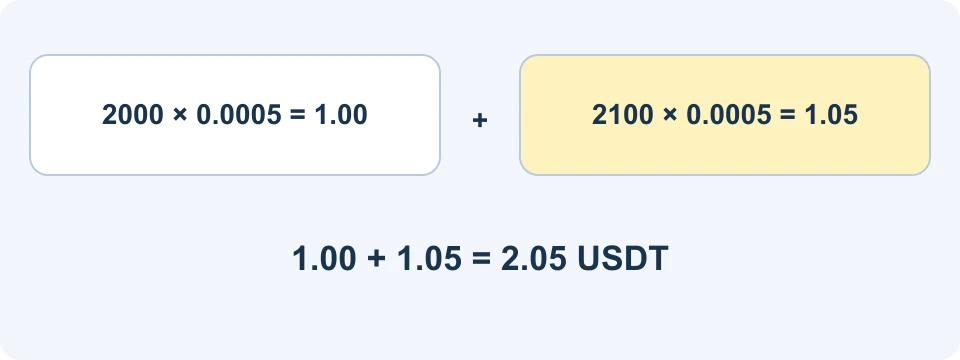
Assume a hypothetical position opens with 2000 USDT of executed value and closes with 2100 USDT. Suppose both executions use the illustrative 0.05% taker rate, with no discount. The opening commission is 1.00 USDT; the closing commission is 1.05 USDT.
| Execution | Executed value | Rate | Commission |
|---|---|---|---|
| Open | 2000 USDT | 0.05% | 1.00 USDT |
| Close | 2100 USDT | 0.05% | 1.05 USDT |
| Total | 4100 USDT of turnover | Applied separately | 2.05 USDT |
Doubling the opening fee would miss 0.05 USDT here. The difference comes from the changed executed value, not a mysterious additional rate. With partial closures, make a row for each fill and keep the remaining position separate from completed turnover.
These figures describe commission only. They do not establish net profit. A result screen may include or exclude costs depending on the metric, so check its definition before subtracting the same commission a second time.
Does leverage multiply the fee?
Once executed notional is known, do not multiply it by leverage again. Consider two hypothetical positions with the same 2000 USDT executed value and the same 0.05% rate. Both produce a 1 USDT commission. Different margin requirements do not change that arithmetic.
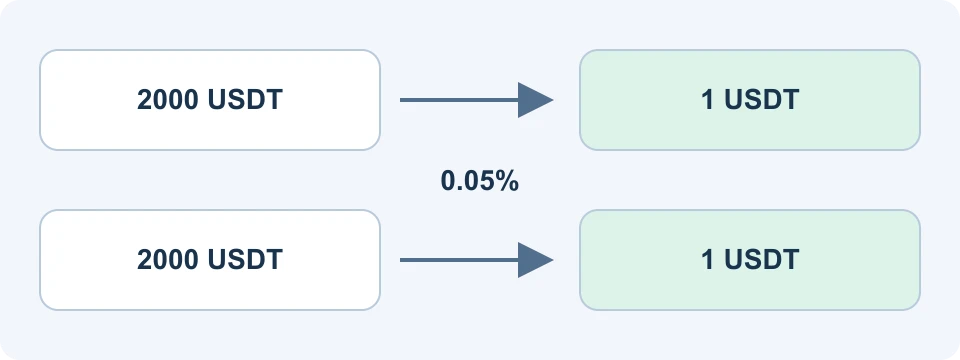
Now change the question: suppose 200 USDT of margin corresponds to 2000 USDT of position value in one simplified example and 4000 USDT in another. At 0.05%, commissions are 1 and 2 USDT. They differ because the second position is larger. This ignores margin buffers and exchange-specific requirements and is not a sizing recommendation.
The distinction also explains why a small commission as a percentage of notional can be substantial relative to posted margin. Fees are only one consideration; higher leverage changes liquidation exposure. The Futures mechanics guide covers the broader position risks.
Commission, funding and liquidation are separate
The Futures cost overview separates trading commission, funding and an Insurance Clearance charge associated with liquidation. The applicable liquidation rules and rates depend on the product. This guide does not assign a universal liquidation percentage.
The funding guide explains that funding transfers between opposing position holders; Binance does not charge a service fee for that transfer. For USD-margined positions, the calculation uses position value based on mark price. Funding can be paid or received, and the interval can vary by contract.
For a hypothetical cost check, start with the earlier 2.05 USDT commission. If funding paid is 0.40 USDT, those two cash costs total 2.45 USDT. If funding received is instead 0.40 USDT, their net cost is 1.65 USDT. Neither example calculates trading profit or predicts the next funding rate.
Slippage is different again: compare the achieved price with an explicitly chosen reference. It is not necessarily a separately billed fee. Keep the reference timestamp and avoid treating a favorable price movement after execution as evidence of an exchange overcharge.
BNB, VIP and referral conditions
The BNB fee-payment FAQ states that eligible Futures trading can receive up to a 10% BNB discount. Its detailed screenshots largely cover Spot, so they should not be treated as proof of the Futures setting. Check the relevant Futures control and required balance; the Futures calculation FAQ specifies sufficient BNB in the Futures account.
A 10% discount on a hypothetical 1 USDT eligible fee leaves 0.90 USDT. It does not reduce a position's 2000 USDT purchase value by 10%. If a discount is unavailable, disabled or inapplicable to the product, calculate using the applicable undiscounted rate.
The U-margined promotion announcement is product-specific and states its own eligibility. Do not treat a promotional percentage, VIP tier and referral offer as automatically additive. In particular, the VELIX referral page must be checked for the actual account, product and regional terms; a Spot benefit does not prove a Futures discount.
How to investigate a fee that looks wrong
Use the executed trade record, not only the order submission screen. Binance's official trade-record documentation distinguishes commission, commission asset, maker status, quantity and execution price. These are the useful fields to reconcile, whether you inspect history in the interface or an existing export.
- Identify the contract and the exact executed fills.
- Check maker/taker status and the fee tier that applied then.
- Keep the charged asset and amount together; do not add different currencies directly.
- Verify the relevant discount balance, setting and conditions.
- Separate commission from funding and other transaction-history entries.
If converting costs to one reporting currency, document the conversion rate and time. An unexplained currency conversion can look like a fee discrepancy. Preserve the original statement and raise unresolved differences through official support with the relevant trade identifiers.
Frequently asked questions
Does an unfilled limit order incur the execution commission?
The commission calculation concerns executed fills. If an order partially filled before cancellation, that filled portion still belongs in the calculation. Check the record rather than assuming cancellation means nothing traded.
Is maker execution always the cheapest overall?
A lower commission rate alone does not answer that question. Fill probability, achieved price and exposure while waiting also matter. This article compares costs without recommending extra trades or a particular order strategy.
Can I use this table next month?
Recheck the official fee page and your account before relying on it. The table above is dated evidence, while examples demonstrate arithmetic that can be reused with current inputs.
Affiliate disclosure: FinanceVelix may earn a commission through its Binance referral link. Account, product and regional conditions apply. Informational calculations are not a recommendation to trade Futures or increase turnover.
Official educational references
- official Futures fee table ↗Source accessed: 2026-10-23
- official fee-calculation guide ↗Source accessed: 2026-10-23
- Futures order-type guide ↗Source accessed: 2026-10-23
- Futures cost overview ↗Source accessed: 2026-10-23
- funding guide ↗Source accessed: 2026-10-23
- BNB fee-payment FAQ ↗Source accessed: 2026-10-23
- U-margined promotion announcement ↗Source accessed: 2026-10-23
- official trade-record documentation ↗Source accessed: 2026-10-23