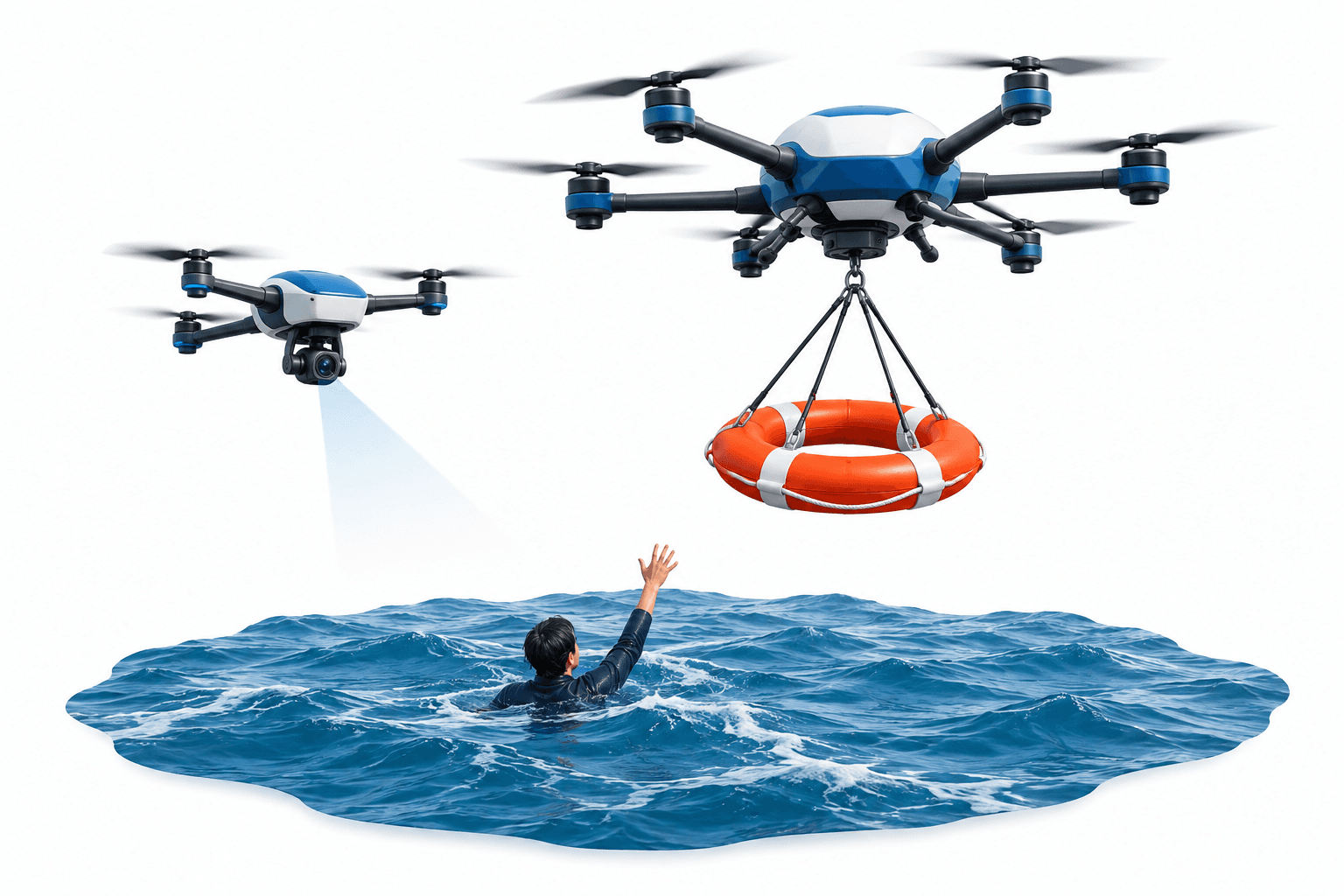
A team at the Indian Naval Academy has developed Indian rescue drones designed to locate people in distress at sea and deliver lifebuoys. The two aircraft divide the search and delivery tasks, with a human operator deciding when to release the flotation equipment.
Key Takeaways
- A quadcopter searches the water, while a hexacopter carries the lifebuoy to a detected location.
- The aircraft communicate by radio, and the delivery drone returns autonomously after releasing the lifebuoy.
How Indian rescue drones work
The search quadcopter uses 2K optical and thermal cameras to scan the water. An artificial intelligence model called YOLO analyses the live video feed to flag a possible person in distress.
Once a potential target is detected, the hexacopter takes off and uses GPS to navigate to the location. Midshipman Sudhanshu Tanwar, one of the developers, said an operator must authorise the lifebuoy drop. The hexacopter then returns to its starting point autonomously.
| Item | Details |
|---|---|
| Flight time | Search quadcopter: 45 minutes; delivery hexacopter: 25 minutes |
| Payload capacity | Search quadcopter: 0.5 kg; delivery hexacopter: 2.5 kg |
| Maximum speed | Search quadcopter: 50 km/h; delivery hexacopter: 40 km/h |
Flight specifications and rescue role
Both aircraft were built by the development team and have an operating radius of 10 kilometres, Tanwar said. They coordinate through a long-range radio-frequency link.
The system is intended to support the initial stages of a maritime rescue by locating a person and delivering flotation equipment without waiting for a boat to reach the precise location.
Read More News
Disclaimer
This FinanceVelix article provides general information, not personalized financial, investment, legal, or tax advice. Market prices, interest rates and economic conditions can change; investments carry a risk of loss. Facts reflect the material available when published and may change. Check important information independently and consult a qualified professional when needed. Mentioning an asset, company, or service is not an endorsement.




Comments
Be respectful. No spam, impersonation or private credentials. Ordinary posts and comments appear immediately; suspicious links are held for review.
Please wait…