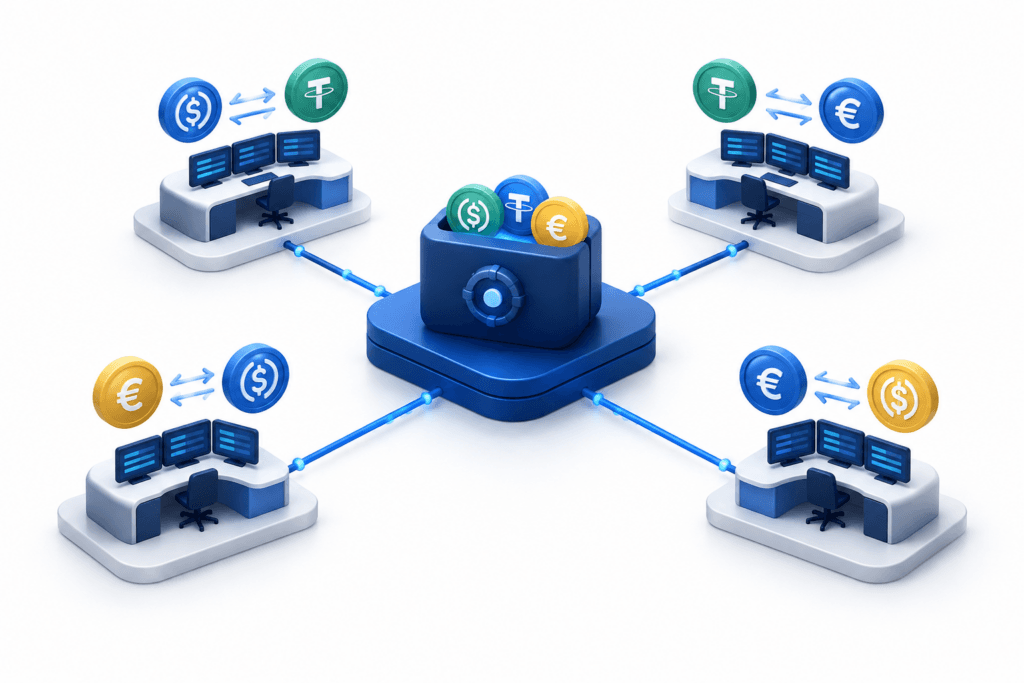
Stablecoin FX rules are set for a clearer place in South Korea’s cross-border payments framework. As of October 23, 2026, the Bank of Korea said it was coordinating with the government on legislation to explicitly treat stablecoins as payment instruments under the Foreign Exchange Transactions Act, with preparation planned within 2026.
Key Takeaways
- The planned stablecoin classification is not yet enacted and does not amount to approval of every stablecoin payment.
- A separate proposed decree already sets out registration and reporting requirements for virtual-asset transfer businesses.
- Foreign-exchange oversight would operate alongside broader legislation covering digital-asset businesses and stablecoin issuance.
Table of Contents
- Stablecoin FX rules would target cross-border use
- An existing monitoring proposal is already further along
- Issuance rules and payment controls address different questions
- Conclusion
Stablecoin FX rules would target cross-border use
The proposed change focuses on stablecoins when they function as a means of moving money between countries, rather than solely as traded crypto assets. Explicitly bringing that use within foreign-exchange law would give authorities a clearer basis for overseeing blockchain-based cross-border payments.
The Bank of Korea also wants stronger monitoring of virtual-asset flows that can bypass conventional banking channels. Traditional foreign-exchange reporting relies on financial intermediaries; transfers through overseas platforms and private wallets can leave gaps in that information.
The stablecoin-specific legislation still needs to be drafted and passed. Its final text and implementing rules will determine reporting thresholds, covered entities and operational obligations.
| Item | Details |
|---|---|
| Underlying statutory amendment | June 2, 2026: amendment addressed monitoring of cross-border virtual-asset transfers. |
| Public consultation | October 7–26, 2026: comment period for the proposed implementing decree. |
| Monitoring implementation target | December 3, 2026: planned alignment with the amended act’s effective date, following required reviews. |
| Stablecoin-specific legislation | Preparation planned within 2026; final requirements and passage remain pending. |
An existing monitoring proposal is already further along
The stablecoin initiative is distinct from work already under way to implement a June 2, 2026 amendment to the Foreign Exchange Transactions Act. The finance ministry’s proposed cross-border virtual-asset reporting framework, announced on October 6, describes registration and reporting obligations for a new virtual-asset transfer business category.
That proposal covers transfers between domestic and overseas virtual-asset service providers, as well as transfers between domestic providers and personal wallets. Providers would report transfer information to the Bank of Korea’s FX Information System, with information shared among tax, customs, financial-supervision and financial-intelligence authorities.
The distinction matters: the ministry document establishes that a monitoring framework is already in development, but it does not establish the separate planned classification of stablecoins as payment instruments. Nor does its reference to personal wallets mean that every wallet holder would have to register as a transfer business.
Issuance rules and payment controls address different questions
South Korea is separately preparing the Digital Asset Basic Act. Financial Services Commission Chairman Lee Eog-weon said discussions on that legislation were nearing completion. The broader framework is expected to address areas including exchange licensing and stablecoin issuance.
The two tracks serve different purposes. Digital-asset legislation can govern who may issue tokens and how crypto businesses operate, while foreign-exchange law governs their use in moving value into or out of South Korea. Progress on one does not settle the requirements under the other.
The Bank of Korea linked its cross-border initiative to money-laundering and regulatory-arbitrage risks, highlighting mixers and unhosted wallets as structures that can complicate identification of counterparties and transaction purposes. It also intends to strengthen international cooperation against illegal digital-asset transfers.
Conclusion
The next scheduled milestone is the October 26 close of consultation on the virtual-asset monitoring decree, ahead of its planned December 3 implementation. For stablecoins specifically, the key document remains the planned legislative draft: it will show how payment-instrument status translates into cross-border obligations.
Read More News
Disclaimer
This FinanceVelix article provides general information, not personalized financial, investment, legal, or tax advice. Market prices, interest rates and economic conditions can change; investments carry a risk of loss. Facts reflect the material available when published and may change. Check important information independently and consult a qualified professional when needed. Mentioning an asset, company, or service is not an endorsement.