You do not need to connect Trust Wallet to your Binance exchange account to transfer crypto. You normally send an on-chain withdrawal or deposit using the destination’s receiving address, matching network and any required memo. Never enter your wallet recovery phrase into Binance or give it to someone offering to connect the accounts.
Trust Wallet is a standalone self-custody wallet; a Binance exchange account is a different custody arrangement. Binance Wallet, integrated into the Binance app, is also a distinct product. Binance Academy states that Trust Wallet, acquired by Binance in 2018, has not been owned or controlled by the Binance Exchange Group since May 2025. See its Trust Wallet explanation.
This FinanceVelix guide uses official public documentation checked on October 23, 2026, plus explicitly hypothetical calculations. It does not report personal wallet use or executed transfers.
Which product controls what?
A familiar brand name does not establish who can sign transactions or restore access. Identify the product before following recovery instructions.
| Product | Custody and access | Your responsibility | Recovery boundary |
|---|---|---|---|
| Binance exchange account | Custodial account; withdrawals follow the exchange’s account and security process. | Protect login credentials and verification methods; supply correct withdrawal details. | Account recovery does not reverse a completed blockchain transfer. |
| Trust Wallet | Self-custody; you control the wallet’s signing secrets. | Protect the recovery phrase and check transactions and approvals before signing. | Trust Wallet does not hold your phrase and cannot restore it for you. |
| Binance Wallet | A separate wallet integrated into the Binance app, with a different security model. | Follow that product’s setup and recovery instructions. | Do not assume Trust Wallet recovery instructions apply. |
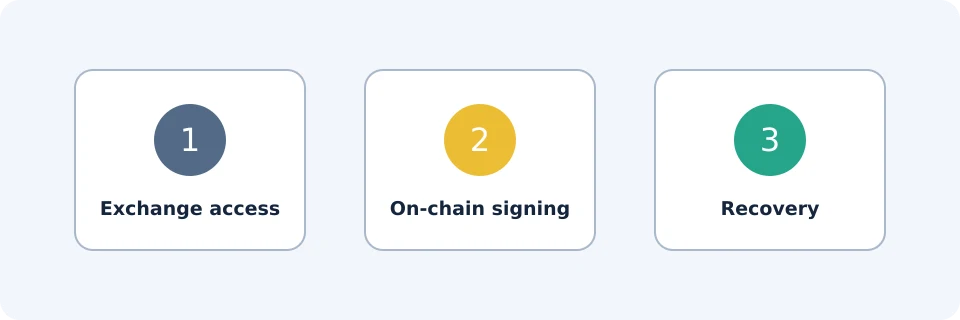
The wallet distinctions and Trust Wallet recovery limitations are documented in Binance Academy. “Inside the Binance app” does not mean every balance uses the same custody model.
Verify the download before creating a wallet
- Find the official Trust Wallet website through the download guidance in the official Academy article, rather than a sponsored search result or unsolicited message.
- Follow the website’s link to the relevant app store or browser extension listing. Compare the destination and publisher information, not just the logo.
- Stop if a download page asks you to submit an existing recovery phrase to verify eligibility, activate transfers or receive support.
- For a new wallet, complete its backup process before funding it. Keep the backup out of email, chat and shared cloud documents.
Do not install a browser extension merely because someone says it is required to transfer funds to Binance. An ordinary transfer needs receiving instructions, not a website connection or seed import.
A transfer checklist for either direction
For the exchange side, compare the current receiving or withdrawal instructions with Binance’s official transfer guide. Binance also explains the separate custody arrangements of exchange accounts and Binance Wallet.
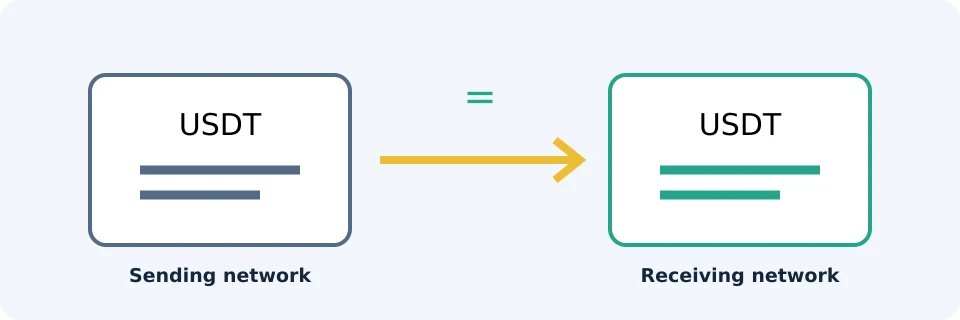
The receiving side sets the requirements. Start there, then configure the sender. A ticker such as USDT identifies an asset label, not a complete transfer route.
| Check | What must agree? | When to stop |
|---|---|---|
| Asset and network | The sender’s selected network and the recipient’s supported network for that asset. | The ticker matches but the network does not. |
| Address | The full destination address from the intended receiving wallet or account. | You relied only on matching first and last characters. |
| Memo or tag | Any additional identifier required by the recipient. | The recipient requires one but the sender’s form is incomplete. |
| Token identity | For contract-based tokens, the correct network and contract. | The token only shares a familiar name or symbol. |
| Amount and costs | Minimums, fees, available balance and expected net receipt. | The test amount would fall below a receiving minimum. |
From Binance to Trust Wallet
In Trust Wallet, select the intended asset on the intended network and obtain its receiving address. In the Binance withdrawal process, select the matching asset and network, enter the address and review any additional destination requirements. Check the displayed fee and net amount before authorizing.
A small test can reduce exposure to an incorrect route, but it does not eliminate risk. Check current minimums first, wait for the test to arrive, and recheck the details before sending more. Our Binance withdrawal guide covers the exchange-side process.
From Trust Wallet to Binance
Obtain current Binance deposit instructions for the exact asset and network. Copy the address and any required memo or tag. In Trust Wallet, choose the corresponding network-specific asset and review the transaction before signing. Consult the Binance deposit guide for receiving-side checks.
Trust Wallet sends require network fees. Keep sufficient native network currency where the selected chain requires it; a token balance alone may not cover gas. Do not choose a cheaper, incompatible network to bypass a fee problem. Academy distinguishes network fees from wallet and third-party service charges.
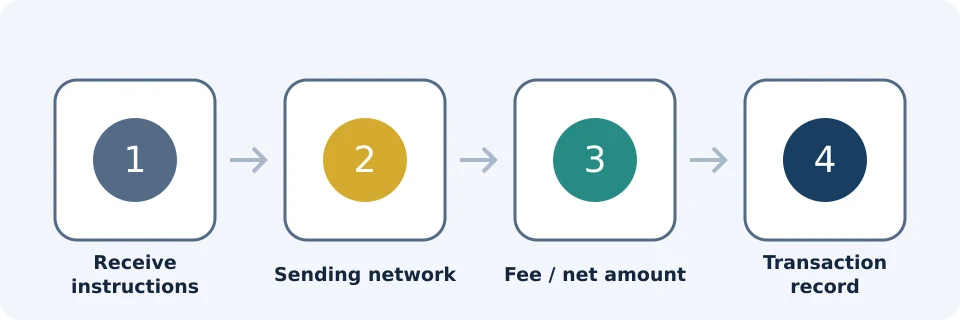
Worked example: reconcile the debit and receipt
Hypothetical assumptions, not live Binance fees: you withdraw 250 units of a token over a network supported by both sides. The preview shows a 1-unit fee deducted from that amount and a 249-unit recipient amount. Assume no other charge and that all minimums are met.
| Record | Expected result |
|---|---|
| Exchange balance reduction | 250 units |
| Displayed withdrawal fee | 1 unit |
| Destination receipt | 249 units |
| Reconciliation | 250 − 1 = 249 |
If the destination receives 249, that matches these assumptions: it is not an unexplained missing token. If the actual preview charges the fee separately, use that different accounting instead.
For a hypothetical return transfer, sending 100 token units while paying 0.0004 units of the network’s native coin means two balances change. Do not subtract 0.0004 from the token amount: they are different assets. Save the transaction hash, network, amount, address and exchange record to reconcile the transfer.
Protect recovery secrets and signing permissions
A recovery phrase can restore control of a wallet; it is not a customer-service verification code. Never provide it to a person, form or “recovery agent.” If you lose the phrase but still have wallet access, secure an appropriate backup before changing devices or deleting the app. Without the phrase or another valid access method, recovery may be impossible.
Also distinguish connecting a wallet from approving token spending. A website connection is not the same as a transfer, but a subsequent approval can authorize a contract to spend tokens. Read the requested network, spender and allowance. Disconnecting a site should not be treated as revoking an on-chain allowance.
If a phrase is exposed, changing the app password does not replace the underlying keys. Stop interacting with the suspected scam and consider moving remaining assets to a newly secured wallet, taking care not to sign further malicious requests. No recovery service can promise success.
When the transfer does not appear
| Symptom | Useful next check | Avoid |
|---|---|---|
| No transaction hash yet | Check the sender’s status and pending security requirements. | Assuming blockchain confirmation has started. |
| Hash exists, transfer pending | Check it on the selected network’s explorer and review destination processing requirements. | Repeatedly sending the same amount. |
| Confirmed, absent in Trust Wallet | Check address, network and token visibility. Verify the contract before adding a custom token. | Assuming an invisible balance proves lost funds. |
| Confirmed, absent at Binance | Compare deposit support, required confirmations, minimum and memo; contact official support with the hash. | Sharing a recovery phrase with support impersonators. |
| Wrong address, network or memo | Preserve records and ask the receiving service about its recovery process. | Assuming recovery is possible or guaranteed. |
Five practical questions
Can identical-looking addresses work on different networks?
Some networks use the same address format. That does not prove the recipient supports the asset on both. Follow the destination’s explicit network instructions.
Does adding a custom token recover a mistaken transfer?
No. It can display a token already held at your address on the selected network. It does not move assets, change networks or make a fake token genuine.
Must I buy TWT to transfer assets?
TWT is Trust Wallet’s governance token, not a universal gas payment token. Check the selected network’s fee asset instead.
Should I import Trust Wallet into my exchange account?
No. An exchange deposit uses its receiving address and required identifiers. Importing a recovery phrase is a wallet-restoration operation, not a deposit method.
Does one successful test make future transfers safe?
It validates that particular route and transaction. Recheck every later transfer because supported networks, receiving instructions, minimums and fees can change.
Affiliate disclosure: FinanceVelix may earn a commission from eligible registrations through its Binance referral link. Using Trust Wallet does not require that link.
Official educational references
- What Is Trust Wallet (TWT)? ↗Source accessed: 2026-10-23
- Your Guide to Binance Deposit/Withdrawal ↗Source accessed: 2026-10-23
- Binance exchange accounts and Binance Wallet ↗Source accessed: 2026-10-23
- Binance VELIX registration offer ↗Source accessed: 2026-10-23