Binance is a cryptocurrency exchange: a service where eligible users can buy, sell, trade and transfer digital assets. An exchange account holds balances within the platform; it is not the same thing as holding cryptocurrency in a self-custody wallet. BNB is a cryptoasset, while BNB Chain refers to blockchain infrastructure—not your Binance account.
For a beginner, the practical questions are whether the service is available where you live, who controls the assets, and what the complete transaction will cost. You do not need to understand every Binance product before answering those questions.
This FinanceVelix guide uses official public documentation and public-page checks dated October 23, 2026. Calculations below are explicitly hypothetical, not live quotes or executed trades. Product availability and account terms can change.
Binance, BNB, BNB Chain and wallets are different
The Binance name appears around several related concepts. Treating them as one shared account can cause expensive mistakes. The BNB Chain documentation identifies BNB as the native utility token of BNB Smart Chain. Binance separately explains custodial and non-custodial wallets and the distinction between exchange balances and Binance Wallet.
| Concept | What it means | Where the balance sits |
|---|---|---|
| Binance exchange account | A platform account for supported purchases, trades and transfers | In the exchange's account records, under its custody arrangements |
| BNB | A cryptoasset, not an account or wallet | Wherever you hold it: an exchange balance or a compatible blockchain address |
| BNB Chain | Blockchain infrastructure, distinct from the exchange | On-chain balances are associated with addresses |
| Self-custody wallet | A tool for authorizing blockchain transactions using keys you control | Assets are recorded on-chain; the wallet manages access rather than storing coins inside the app |
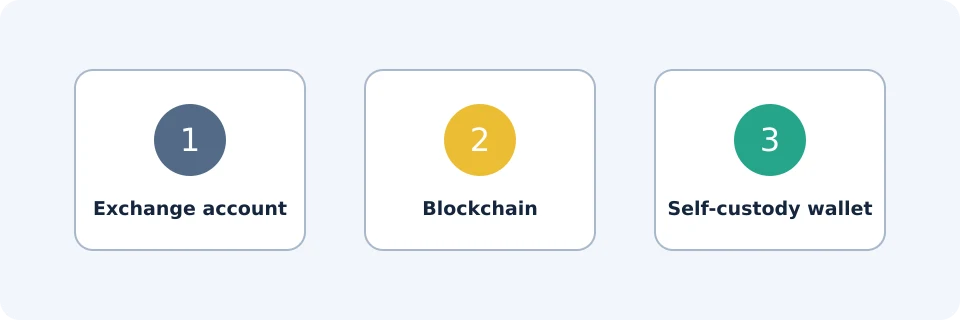
A Binance balance is therefore not automatically available in an external wallet. Moving assets between them requires a supported transfer. Conversely, owning BNB does not mean you have a Binance account.
What is Binance used for?
Start with the task, not the product menu. Binance's official beginner guide describes card purchases, bank transfers, Convert, Spot trading and peer-to-peer trading. These are possible routes, not a promise that every account can use each one.
| Your task | Route to investigate | Cost or responsibility to inspect |
|---|---|---|
| Buy crypto with local currency | Available card, bank or P2P route | Payment charges, exchange rate and final crypto received |
| Exchange one supported asset for another | Convert or Spot | Quote, spread, trading fee and execution conditions |
| Send crypto to another platform or wallet | Crypto withdrawal | Network compatibility, withdrawal fee and destination requirements |
| Use an on-chain application | A compatible wallet and blockchain | Key custody, network fees and application permissions; an exchange balance alone is insufficient |
Keeping assets on an exchange leaves you dependent on its access controls and withdrawal processing. Self-custody changes that responsibility: you must protect recovery material and authorize transactions correctly. Neither arrangement removes market risk.
How buying and trading work
1. Establish access and funding
Check availability for your residence and intended product before sending money. Follow the account's verification requirements; Binance's official guide says identity verification is required before purchasing crypto. Acceptance of a payment method does not establish access to every other service.
A fiat deposit moves supported traditional currency into the platform. A crypto deposit transfers an asset from another platform or blockchain address. Neither is itself a trade. Use the registration and verification guide for a more focused walkthrough.
2. Choose a quote or an order
Convert provides a source-asset-to-destination-asset quote to review before acceptance. Compare the amount received, not just whether a separate fee is displayed.
Spot trading uses trading pairs, such as BTC/USDT. Buying that pair exchanges USDT for BTC. A market order takes available liquidity, so its execution price can differ from an earlier displayed price. A limit order sets a price constraint but may remain unfilled or fill only partly. See the official overview and FinanceVelix's Spot order guide.
P2P involves another user and an external payment method. Escrow is part of the process, not a guarantee against every payment dispute. Keep the order and communication within the platform's process, and never treat a payment screenshot as proof of receipt.
3. Withdraw only when the destination is ready
A trade changes your exchange balances; a withdrawal sends assets out. Confirm the asset, network, destination address and any required memo or tag. Matching the asset name alone is insufficient if the destination does not support the selected network.
Review the fee and net amount before confirmation. A small test can reduce exposure, but first check minimums and whether two withdrawal fees would be disproportionate. Incorrect transfers may be unrecoverable.
A beginner route before committing funds
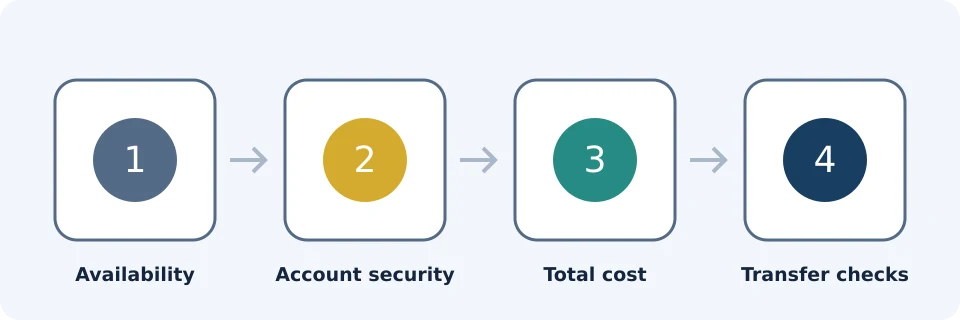
- Check access: confirm residence eligibility, verification requirements and the specific payment or trading service.
- Secure access: use a unique password, enable appropriate additional authentication and protect recovery access.
- Define one task: buying, exchanging and withdrawing are separate actions with separate checks.
- Preview the full cost: record what you pay, what you receive and any later transfer cost.
- Inspect the result: distinguish a submitted order, an executed trade and a completed withdrawal in the relevant records.
Binance documents authenticator-based verification, passkeys and an anti-phishing code in its security overview. An email recognition code is only one signal; navigate directly to the official service rather than trusting an unexpected message. Never share authentication codes or wallet recovery secrets.
Calculate the complete cost, not one advertised fee
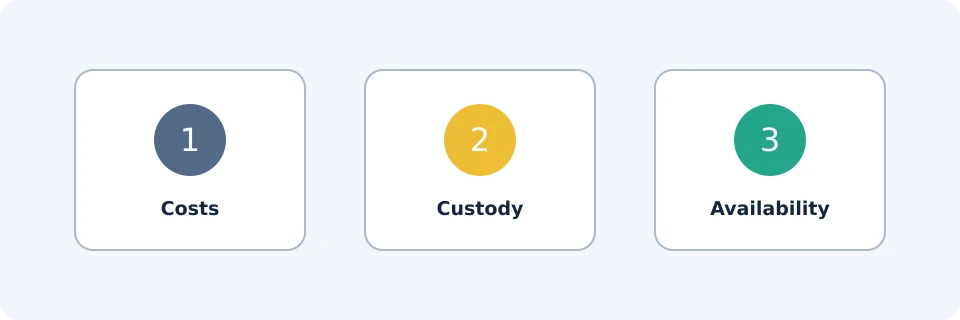
Separate payment charges, trading costs, quote differences and withdrawal charges. A route with a lower trading fee can still deliver less crypto after funding and withdrawal.
Hypothetical all-in budget: assume a $200 budget, a $2 payment charge, a fixed asset price of $50, a 0.10% trading fee charged on executed value in addition to that value, and a later withdrawal charge of 0.02 asset units. These are invented assumptions, not Binance rates.
- Cash available after the payment charge: $200 − $2 = $198.
- The buy and its fee must fit inside $198, so executed value = $198 ÷ 1.001 = approximately $197.802198.
- Trading fee = $197.802198 × 0.001 = approximately $0.197802.
- Asset acquired = $197.802198 ÷ $50 = approximately 3.956044 units.
- Destination receives approximately 3.956044 − 0.02 = 3.936044 units.
At the assumed unchanged price, the destination value is approximately $196.8022, a $3.1978 difference from the original budget. Displayed figures are rounded. Actual execution, precision and fee denomination can change the result. The fee guide explains how to reconcile each charge.
Do not treat referral rebates, BNB fee deductions and welcome-reward tasks as interchangeable. They have different eligibility and calculation rules; do not assume universal stacking or include an unearned reward in your budget.
Troubleshoot the stage that failed
| Problem | Check first |
|---|---|
| A purchase method is unavailable | Residence, verification status, supported currency and payment-provider restrictions; do not bypass restrictions |
| An order exists but the balance has not changed | Whether it is open, partially filled, rejected or completed |
| A transfer has not arrived | Sending status, transaction identifier, confirmations, destination processing and any memo requirement |
| The received amount is lower than expected | Payment charge, execution price, fee asset and withdrawal deduction |
Frequently asked questions
Must I buy BNB to start?
No. BNB is not the account itself. Whether holding it is useful depends on your intended transaction and any applicable fee-deduction terms.
Does Binance guarantee a profit?
No. Access to an exchange does not make an asset profitable or protect its value. Fee reductions cannot offset an unlimited market loss.
Is withdrawing to a bank the same as sending crypto?
No. A supported fiat withdrawal uses a banking or payment route. A crypto withdrawal uses an asset, network and destination address. Availability and charges must be checked separately.
Do I need to fund an account to learn?
No. Read documentation, compare hypothetical costs and understand custody first. Funding an account is not a prerequisite for learning how exchanges work.
Affiliate disclosure: FinanceVelix may earn a commission if you register through its Binance referral link. This guide does not promise eligibility, rewards or returns.
Official educational references
- Binance beginner guide ↗Source accessed: 2026-10-23
- BNB Smart Chain developer quick guide ↗Source accessed: 2026-10-23
- Binance crypto wallet types and custody ↗Source accessed: 2026-10-23
- Binance exchange accounts and Binance Wallet ↗Source accessed: 2026-10-23
- Binance VELIX registration offer ↗Source accessed: 2026-10-23