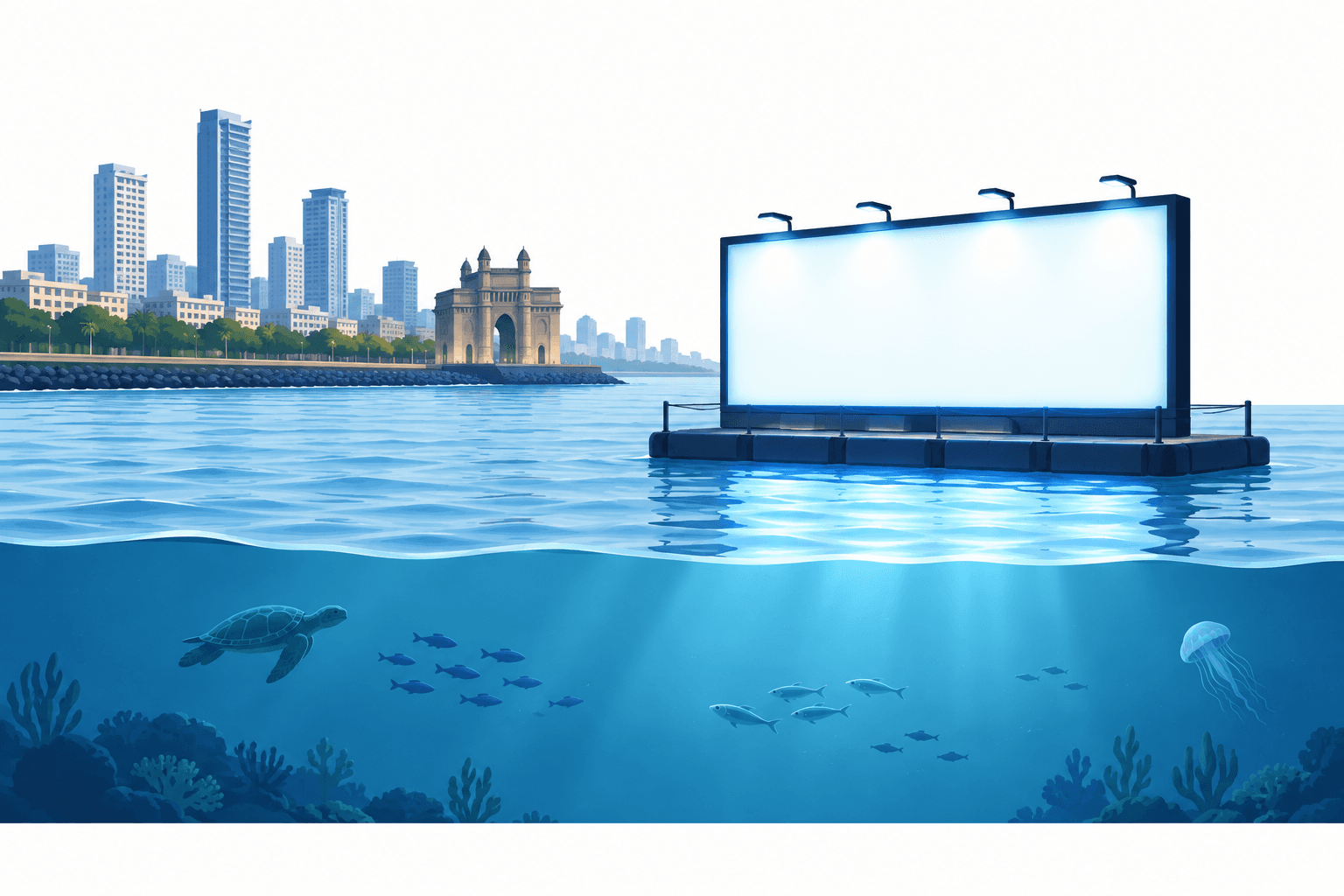
Mumbai floating billboards are being planned by the Maharashtra Maritime Board, raising concerns that digital advertising could add artificial light to coastal habitats. As of October 27, 2026, the board had identified 20 locations for shore-based and floating advertisements.
Key Takeaways
- The identified locations include Juhu Beach, Lotus Jetty at Worli and Bandra Sea Link Jetty.
- Researchers and conservation advocates warn that artificial light can disrupt marine animals’ behavior.
Mumbai floating billboards and coastal habitats
The proposed advertising installations could introduce concentrated light at the waterline. The identified sites cover both shore-based and floating advertisements; the source does not specify how many would be floating.
Minu Agarwal, an assistant professor at CEPT University and a founding member of DarkSky India, said artificial illumination could interfere with zooplankton’s daily movement between deeper water and the surface. That movement affects feeding, predator avoidance and energy transfer through marine food webs.
What research and conservation guidelines say
A study by Plymouth Marine Laboratory and the University of Plymouth found that about 22% of the world’s coastal waters are consistently exposed to artificial light at night. White and blue-rich LED light can penetrate up to 40 metres into water.
Research has also documented artificial lights disorienting Olive Ridley turtle hatchlings, drawing them inland rather than toward the sea. An Olive Ridley sighting at Juhu Beach in 2025 drew attention to the loss of nesting grounds along crowded, brightly lit beaches.
Guidelines on light pollution affecting migratory species, formalised in 2024 under the Convention on the Conservation of Migratory Species of Wild Animals, recommend a 20-kilometre light-free buffer around important wildlife habitats and environmental impact assessments for proposed illuminated sites.
Ways to limit illumination
Mathi Thumilan, co-founder of Wild and Dark Earth, recommended warmer-spectrum lighting, brightness limits and timers to reduce illumination after active hours. He argued that preventing pollution was preferable to managing it after it became widespread, and warned that commercial billboards could grow beyond the initial plan.
Read More News
Disclaimer
This FinanceVelix article provides general information, not personalized financial, investment, legal, or tax advice. Market prices, interest rates and economic conditions can change; investments carry a risk of loss. Facts reflect the material available when published and may change. Check important information independently and consult a qualified professional when needed. Mentioning an asset, company, or service is not an endorsement.




Comments
Be respectful. No spam, impersonation or private credentials. Ordinary posts and comments appear immediately; suspicious links are held for review.
Please wait…