To buy Bitcoin on Binance, first check that the service and your payment method are available to your account. Select BTC, compare the amount you will actually receive, confirm the payment or trade, and check the completed balance. Moving that BTC to a wallet is a separate decision with its own network and fee checks.
The useful comparison is not the biggest “Buy” button or a headline fee. It is how much usable BTC reaches the place where you intend to hold it for the same total cash outlay. This guide focuses on that comparison, order checks and Bitcoin-specific transfer choices.
Source note: public Binance documentation was checked on October 23, 2026. The worked figures below are hypothetical examples, not live quotes or executed purchases.
Before buying: check access and choose BTC
Use the official service for your jurisdiction and complete its identity requirements. A Binance.com guide does not establish eligibility for a different legal entity or country. If a product or payment method is unavailable, use the supported local options rather than trying to bypass the restriction.
Check the asset ticker, not just a familiar logo. Bitcoin is BTC; Bitcoin Cash is BCH. A derivative whose name contains BTC is also a different product from buying BTC on the Spot market. You do not need leverage or a Futures position to make a Spot purchase.
Secure account access before funding it. The registration and verification guide and account security guide cover those checks without repeating the full setup here.
Choose the route that fits your starting balance
The official Bitcoin purchase page lists several possible routes, including card payments, Convert, Spot and P2P. Availability depends on the account, location and currency. A public landing page listing a method is not an account-specific approval or a final quote.
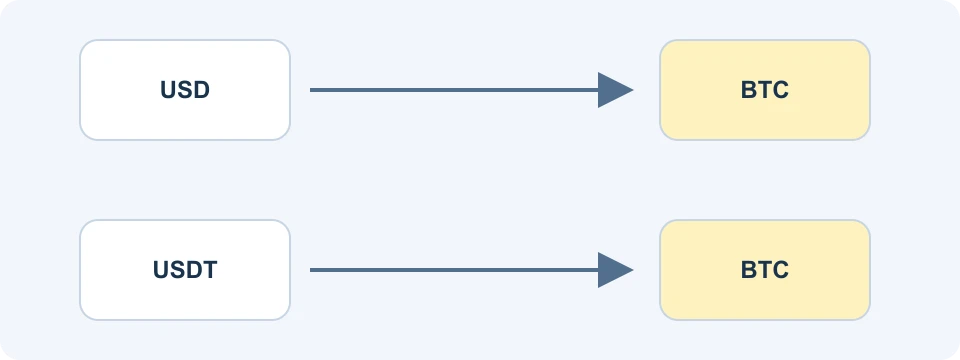
| Starting point | Route to investigate | What to compare |
|---|---|---|
| Local currency outside Binance | An available direct payment or fiat-funding route | Total card or bank debit and final BTC received |
| A supported balance on Binance | Convert or an available BTC Spot pair | Quote, order execution and fee asset |
| A supported P2P payment method | An eligible P2P listing and its stated settlement process | Advertised exchange rate, limits, counterparty terms and any next conversion |
Buying a stablecoin first can be an available intermediate step, but it is not automatically necessary or cheaper. Include its acquisition cost and the later BTC trade in the comparison. If using P2P, follow the platform's order and payment process; do not transfer money outside an established order because someone promises a better rate. See the P2P guide for the separate counterparty and settlement checks.
Compare net BTC for the same total amount paid
Record the cash total, the quote expiry, the expected BTC credit and any separately charged payment cost. Compare quotes close together in time because the market can move between screens. A difference observed several minutes later might reflect price movement rather than a cheaper payment method.
For a purchase ending inside the exchange, divide total cash paid by the net BTC credited. If your intended endpoint is an external wallet, use the BTC expected after the withdrawal charge instead. Keep the endpoint consistent across every route.
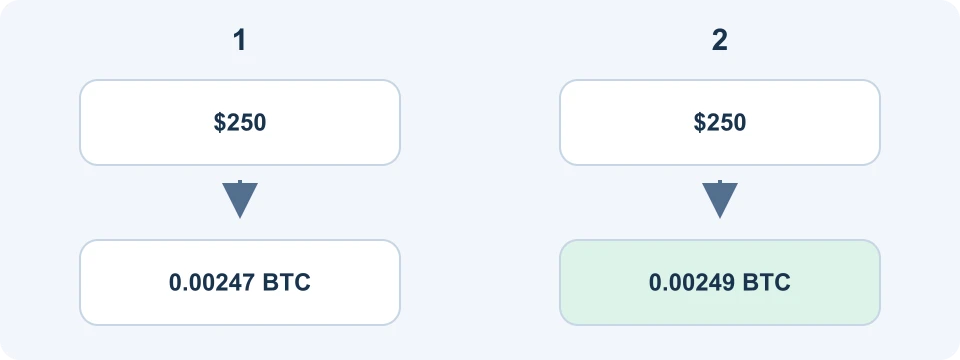
| Hypothetical quote | Total cash paid | Net BTC credited | Effective cash cost per BTC |
|---|---|---|---|
| Route 1 | $250 | 0.00247 BTC | Approximately $101,214.57 |
| Route 2 | $250 | 0.00249 BTC | Approximately $100,401.61 |
Calculation: $250 divided by 0.00247 or 0.00249 BTC. Under these invented assumptions, route 2 gives 0.00002 BTC more for the same outlay. That identifies the better of these two particular quotes; it does not prove that one named payment method is always cheaper.
Both figures assume all purchase-stage charges are already included. Do not subtract the same fee again. If the bank adds a separate card or currency-conversion charge, add it to the cash numerator. If a fee is charged in another cryptoasset, record that additional cost rather than ignoring it because the BTC balance looks unchanged.
A referral rebate or unearned promotional reward should not be counted as cash already received. Compare the purchase on its own terms first, then reconcile any eligible rebate separately. The trading-fee guide explains that distinction.
If using Spot, check the pair and the actual fill
On a BTC/USDT Spot pair, BTC is the asset being bought and USDT is the asset spent. Confirm that the pair is available to your account and that the spending balance is usable in the relevant account. A balance elsewhere in the platform may require an internal transfer first.
A market order takes available offers. The executed price can differ from an earlier display, especially when the requested quantity reaches several price levels. A limit order sets a price constraint, but it can remain open or fill only partly. A limit order is not automatically a completed purchase.
Use these records to distinguish the result:
- Order record: requested amount, order type, status and any unfilled remainder.
- Trade or fill record: quantity and price actually executed.
- Fee record: fee amount and the asset in which it was charged.
- Balance record: BTC now credited and any amount reserved by other open orders.
For example, if an order requests 0.003 BTC but fills only 0.001 BTC, you have acquired the filled 0.001 BTC, not the requested total. Cancelling the remaining order does not undo that fill. The Spot order guide provides fuller order examples.
Before withdrawing, match the receiving route
Keeping BTC on Binance means relying on the exchange's custody and access arrangements. Withdrawing to a self-custody wallet changes who manages access and recovery. It does not remove price risk, and buying BTC does not automatically move it to a personal wallet.
Start from the receiving service's instructions. Confirm the supported asset and network, then choose the matching withdrawal option. Binance's deposit and withdrawal guidance warns against choosing a network merely because its fee is lower.
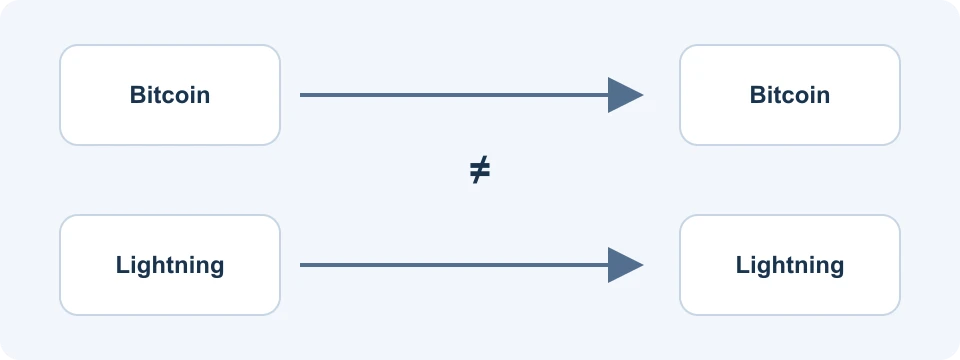
For a Bitcoin-network transfer, use the destination's compatible Bitcoin receiving details. If considering Lightning, check that both sides and your region support it. Binance's Lightning guide describes an invoice flow with amount and expiry requirements. An expired invoice or an ordinary blockchain address is not a substitute for the required invoice.
A token representing BTC on another blockchain is not automatically acceptable to a Bitcoin-only destination. Check the actual receiving asset and network, even if the ticker looks familiar. Before confirming, inspect the withdrawal minimum, fee and net amount. A small test can reduce exposure, but account for minimums and the cost of a second transfer. Use the withdrawal guide for the final checklist.
Diagnose the stage that failed
| What you see | Check before trying again |
|---|---|
| Payment declined | Payment-provider message, eligibility and order status; avoid repeated submissions while a debit is unresolved |
| Money debited but no BTC visible | Purchase status, receipt and the destination balance shown by the order |
| Spot order open | Filled quantity, remaining quantity and the chosen limit price |
| Less BTC than expected | Actual execution, fee denomination, all-in payment amount and any later transfer deduction |
| Withdrawal pending | Withdrawal record and destination processing, rather than submitting another purchase |
Keep the order identifier, amount and time when contacting official support. Never send a recovery phrase, private key or one-time authentication code to someone offering to fix a purchase.
Frequently asked questions
Do I need to buy a whole Bitcoin?
No. BTC can be acquired in fractions. The relevant constraint is the current payment or trading minimum and permitted precision shown for your route, not the cost of a whole coin.
Which route has the lowest cost?
There is no universal answer. Compare final net BTC for the same total spend and endpoint. Include an intermediate conversion or intended withdrawal where applicable.
Can a US reader follow the Binance.com flow?
Do not assume so. Verify the official service and products available in your location. A search result for Binance.US is a separate service context, not proof that a Binance.com account or offer applies.
How long until BTC arrives?
Payment processing, order execution and external withdrawal are separate stages. Use the status of the actual stage instead of treating a marketing estimate as a guaranteed end-to-end time.
Affiliate disclosure: FinanceVelix may earn a commission if you use its Binance referral link. Eligibility and benefits depend on the displayed account, product and regional terms. A fee benefit is not a reduction in Bitcoin's market price.
Official educational references
- Binance official Bitcoin buying guide ↗Source accessed: 2026-10-23
- Binance network matching and crypto transfers ↗Source accessed: 2026-10-23
- Binance Bitcoin Lightning invoice guide ↗Source accessed: 2026-10-23